
The AI Growth Layer: The Scalability Pillar That Fails on the Best Day
Written By: Shane Clark on May 23, 2026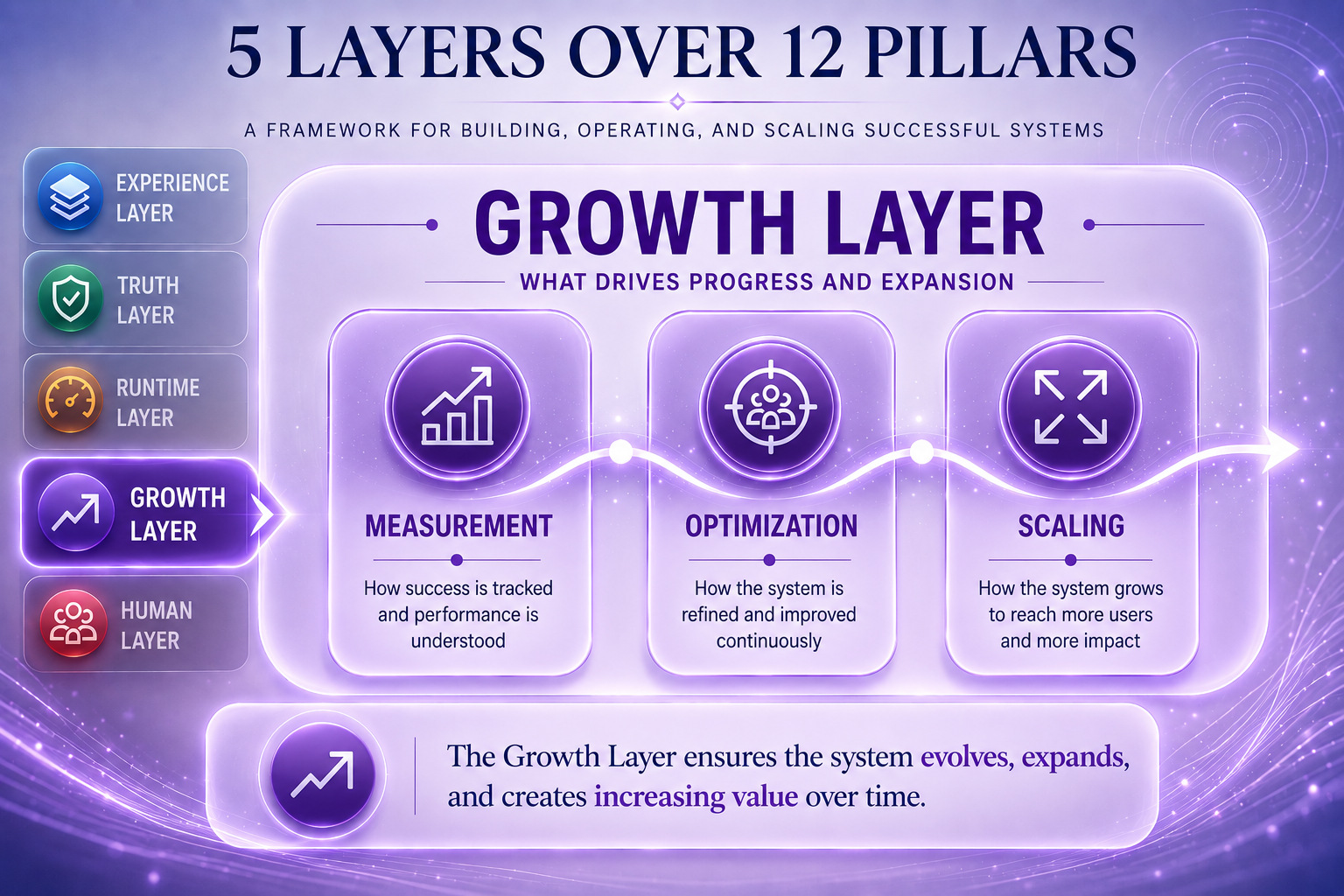
What is the AI growth layer?
The AI growth layer holds the Scalability pillar: the one that fails only when the product finally gets busy. AI ships code that works for twenty records and breaks at two thousand. An operator who inspects the growth layer catches this before a real client does.
The AI growth layer is the part of AI-built software that works perfectly on the day you ship it and fails on the day you scale. It holds one pillar, Scalability, and the pillar matters most precisely because nothing in it surfaces in early testing. The product works for the first twenty users, the first hundred records, the first dozen items in a dropdown. Then the client signs a big customer, or the data grows, or the launch goes well, and the product breaks on the busiest day.
This post is the fourth in a five-part series that walks through the 12 pillars of an effective AI operator one layer at a time. The cornerstone post lays out all twelve in one map. The previous post covered the AI runtime layer, where bugs surface under real-user conditions. This post goes one layer further out, to the bug that surfaces only when the system grows.
Specifically, the growth layer holds one of the twelve pillars: Scalability. One pillar, not three or four, because the failure mode is singular. Things that work fine at 20 users do not work at 2,000. Things that work fine with 100 records do not work with 1,000,000. A scrollable dropdown with 20 items is perfectly usable. The same dropdown with 2,000 items is unusable. The pattern repeats across every part of the system.
Why the AI growth layer is the one people forget most
First, this is the layer that does not surface in any test. Experience-layer bugs surface on the developer’s screen. Truth-layer bugs surface in the first query. Runtime-layer bugs surface under network throttling. In contrast, growth-layer bugs surface only when the system actually grows, which by definition is a future event. So the inspection has to happen on imagination, not observation.
Then add the worst possible failure mode. Scalability bugs fail on the client’s best day. The day the launch goes well, the marketing campaign converts, the influencer post lands, the contract gets signed. The day the product is supposed to prove its worth is exactly the day the product breaks. As a result, the growth layer is where AI builds the most invisible time bombs, and where an AI business automation audit earns its keep by surfacing the bombs before they detonate.
Scalability: when 20 items work and 2,000 do not
Scalability is the discipline of asking “what happens when this gets large?” for every UI element, every query, every list, every process in the system. AI does not ask this question because AI builds for the example in front of it. Tell AI “show a dropdown of states,” and AI ships a dropdown of states. AI does not ask “what if there are 2,000 instead of 50?” because the spec said states, and there are 50 states.
The most common Scalability bug AI ships is the scrollable dropdown that fails at scale. Twenty items, fine. Two thousand items, unusable, because the user cannot find anything in the scroll. Two hundred thousand items, the page crashes the browser. The fix is type-ahead search or a paginated picker. The bug is that AI did not build either, because nothing in the small case demanded it.
Beyond dropdowns, the pattern repeats in tables, lists, queries, background jobs, and exports. A query that takes 80 milliseconds against 1,000 rows takes 8 seconds against 100,000 if the developer forgot the index. An export job that runs in 30 seconds against 50 records runs out of memory at 50,000. Google Cloud’s scalable architecture guide walks through the patterns in detail, but the inspection question is simpler: for every quantity in the system, ask “what happens at 100x?”
How an operator inspects the AI growth layer
Run the one pillar by imagination, not observation. For every list, dropdown, table, query, and process in the system, ask: “what happens when this is 100x its current size?” Not 10x, not 50x. 100x. The 100x question forces the failure mode to surface because 10x usually still works.
In practice, this pass is the fastest of the five layers, usually 15 to 30 minutes on a single feature, because it is purely a question-asking exercise. The bugs you find are not always cheap to fix, yet they are always cheap to spot. An afternoon of 100x questions across a project surfaces every Scalability bug worth catching, and the fixes can be scoped against the project’s actual growth horizon. The same disciplined catch-and-fix cycle shows up across every well-run AI automation cycle, and it scales human attention across AI-assisted insourcing work without growing the team.
Notably, this is the layer where the audit’s value is highest in expectation. A Scalability bug that goes uncaught and surfaces on the client’s busiest day can cost the entire client relationship in a single afternoon. A 30-minute Scalability pass that catches it before launch is the highest-ROI thirty minutes in the entire 12-pillar framework. That is what an audit pays for.
The next layer
The growth layer holds the bug that surfaces only when the system scales. The final layer, the human layer, holds the bugs that have nothing to do with the software at all. Communication: telling the client what you found before they have to ask. Situational Awareness: seeing a problem before it exists. Together they are the layer that holds the other four together, the layer that decides whether the operator is competent or just present. That is the next and final post in this series.
For the full 12-pillar map, the cornerstone post on the AI operator role lays out all five layers in one place.
Final thoughts: get a second set of eyes
I am the AI operator agencies and small teams hire when they need to know which of their AI-built systems is going to fail on the busy day. I run the one growth-layer pillar after the other nine, and I write up exactly which pieces of the product will break at 100x and what the fix would cost. If that is the kind of work you want done on your project, an AI business automation audit walks all twelve pillars across the five layers, and the audit pricing page has the numbers.
I am Shane, and I run ShaneWebGuy, a fully digital web development and AI automation studio serving 24 US cities.
Frequently asked questions
I audit AI-built software across all five layers before it ships to clients. If you want an operator’s eyes on your next project, an AI business automation audit covers every pillar.
Why does AI miss Scalability bugs?
Because AI builds for the example in front of it, not for the future state of the system. The spec says "show a dropdown of states," AI ships a dropdown of 50 states, the dropdown works. AI does not ask "what if there are 2,000 items instead of 50?" because nothing in the small case demanded the question. The bug only surfaces when the small case becomes the large case.
What is the most common Scalability bug AI ships?
A scrollable dropdown that works at 20 items and is unusable at 2,000. The fix is type-ahead search, a paginated picker, or a different UI pattern entirely. AI does not ship any of those by default because the small case does not require them. The same pattern repeats in tables, lists, queries, and background jobs across the rest of the system.
Why is the growth layer the most dangerous?
Because Scalability bugs fail on the client's best day. The day the launch succeeds, the contract closes, the campaign converts. That is exactly the day the product breaks, and the breakage costs trust precisely when you need the trust most. Other bug categories fail at random times. Scalability bugs are perfectly timed to ruin the client relationship.
How do you inspect for Scalability bugs?
Ask the 100x question. For every list, dropdown, table, query, and process in the system, ask "what happens when this is 100x its current size?" Not 10x. 100x. The 100x question forces the failure mode to surface because 10x usually still works. An afternoon of 100x questions across a project surfaces every Scalability bug worth catching.
How long does a Scalability inspection take?
Usually 15 to 30 minutes on a single feature, because the inspection is pure question-asking rather than measurement. It is the fastest of the five layers to inspect. The fixes themselves are not always cheap (a paginated picker is real work), yet spotting the bugs is the cheap part. The 30 minutes of inspection is the highest-ROI half-hour in the entire 12-pillar framework.
Can AI catch its own Scalability bugs?
Not reliably. AI builds for the case it was given and does not extrapolate to a future case. If the spec mentions 50 items, AI ships for 50. AI will not ask "what if there are 50,000?" because the spec did not mention 50,000. That gap between what was specified and what will exist when the system runs in production is the Scalability gap, and only a person asking the imagination-based questions can close it.
